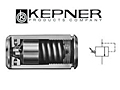
Series 1354 Kepsel® Adjustable Cartridge Relief Valve
(3) The Kepsel® cartridge has the same internal features as its counterpart Kep-O-seal® adjustable inline relief valve. These adjustable, spring-loaded poppet valves are used to limit system pressure. Excess pressure unseats the poppet, allowing flow with minimal increase in system pressure. As fluid is released the system pressure decreases until the spring force re-seats the poppet. Kepner's Flexible Seal Seat™ ensures bubble-tight shutoff of liquid or gas. The relief pressure can be set using a tamperproof internal adjustment screw. Standard and specialty valves handle a wide variety of relief applications, and are ideal for use in a manifold, sub-plate, or cylinder head.
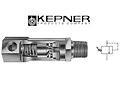
Series 2300 Kep-O-seal® Adjustable Relief Valve
(10) These adjustable, spring-loaded poppet valves are used to limit system pressure. Excess pressure unseats the poppet, allowing flow with minimal increase in system pressure. As fluid is released the system pressure decreases until the spring force re-seats the poppet. Kepner's Flexible Seal Seat™ ensures bubble-tight shutoff of liquid or gas. The relief pressure can be set using a tamperproof internal adjustment screw. Standard and specialty valves handle a wide variety of applications requiring fast acting relief performance and tamperproof pressure adjustment.
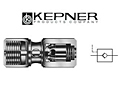
Series 2740 Kepsel® Cartridge Lock Valve
(5) The cartridge lock valves combine a Kepsel® Cartridge Insert Check with a rugged pilot operator, and function the same as the counterpart Kep-O-Lok® inline lock valve. They free flow from valve port to cylinder port (or portion of circuit) and “lock” reverse flow until pilot pressure is applied to unlock the internal check valve and allow reverse flow. Kepner's Flexible Seal Seat™ provides positive bubbletight locking to prevent load drift or circuit creep, and answers the need where internal leakage could adversely affect performance such as with clamping cylinders or outrigger stabilizer jacks. Standard and specialty valve designs handle a wide variety of block and load hold applications, and are ideal for use in manifolds, subplates, or cylinder heads.
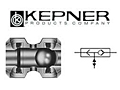
Series 2250 Kepsel® Cartridge Shuttle Valve
(5) The cartridge shuttle valve permits flow from either of two inlet ports to a common outlet. Similar to the Kep-O-seal inline version, a free floating metal ball shuttles according to the relative pressure at the two inlets. The higher pressure inlet flows through the valve and moves the ball to close the opposite inlet. Kepner's Flexible Seal Seat™ ensures bubble-tight shutoff of liquid or gas, and long service life. Shuttle valves can also flow in the reverse direction, and relieve system pressure when input is removed. Standard and specialty valves handle a wide variety of applications, and are ideal for use in manifolds, subplates, or cylinder heads.
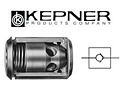
Series 2200 Kepsel® Cartridge Check and Relief Valve
(9) Kepsel® cartridge valves are designed for simple installation (no expensive machining for cavity) and offer the same outstanding performance as their counterpart Kep-O-seal® inline valves. These springoperated poppet valves, with optional relief settings, allow free flow in only one direction and prevent backflow.They also are used for relief and by-pass functions; however, they should not be used as safety valves. Kepner's Flexible Seal Seat™ ensures bubble-tight shutoff of liquid or gas, and long service life. Standard and specialty valve designs handle a wide variety of applications, and are ideal for use in sub-plate and manifold assemblies, pump inlet/outlet, and cylinder blocks.
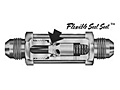
Check / Relief Valves
These spring-operated poppet valves, with optional relief settings, allow free flow in only one direction and prevent backflow – sometimes referred to as “backflow preventor”, “flow stop”, or “non-return” valve. They also are used for relief and by-pass functions; however, they should not be used as safety relief valves. Kepner's Flexible Seal Seat™ combines metal-to-metal contact with a resilient seal seat ensuring dependable bubble-tight shutoff of liquid or gas, and long service life. Standard and specialty valve designs handle a wide variety of applications.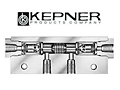
Series 2800 Kep-O-Lok® Dual Lock Valve
(7) These rugged valves combine two Kepsel® Cartridge Check Valves with close fitting pilot piston shuttle to offer dependable cylinder locking in both directions. They permit free flow from valve port to cylinder port (or to portion of circuit) through one check valve while at the same time piloting open the check valve on the other side to allow reverse flow. When pressure at the valve ports is removed both check valves close and lock against movement in either direction by preventing reverse flow. Kepner's Flexible Seal Seat™ provides positive bubble-tight locking to prevent load drift or circuit creep. Standard and specialty valve designs handle a wide variety of applications, and are commonly used with double acting cylinders for position locking and for holding against line rupture or control valve leakage.
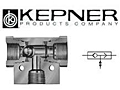
Series 2450 Kep-O-seal® Shuttle Valve
(5) The shuttle valve permits flow from either of two inlet ports to a common outlet. A free floating metal ball shuttles according to the relative pressure at the two inlets. The higher pressure inlet flows through the valve and moves the ball to close the opposite inlet. Kepner's Flexible Seal Seat™ combines metal-tometal contact with a resilient seal seat to ensure bubble-tight shutoff of liquid or gas, and long service life. Shuttle valves can also flow in the reverse direction, and relieve system pressure when input is removed. Standard and specialty valves handle a wide variety of control applications, including use in logic circuits, for pilot signal input and venting, dual input pilot control, and for switching to alternate or standby systems.
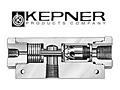
Series 2700 Kep-O-Lok® Single Lock Valve
(7) The lock valve combines a Kepsel® Cartridge Insert Check with a rugged pilot operator. They free flow from valve port to cylinder port (or to portion of circuit) and “lock” reverse flow until pilot pressure is applied to unlock the internal check valve and allow reverse flow. Kepner's Flexible Seal Seat™ provides positive bubble-tight locking to prevent load drift or circuit creep, and answers the need where internal leakage could adversely affect performance such as with clamping cylinders or outrigger stabilizer jacks. Standard and specialty valve designs handle a wide variety of applications for dependable position and load holding, including safety holding against line rupture or control valve leakage.